
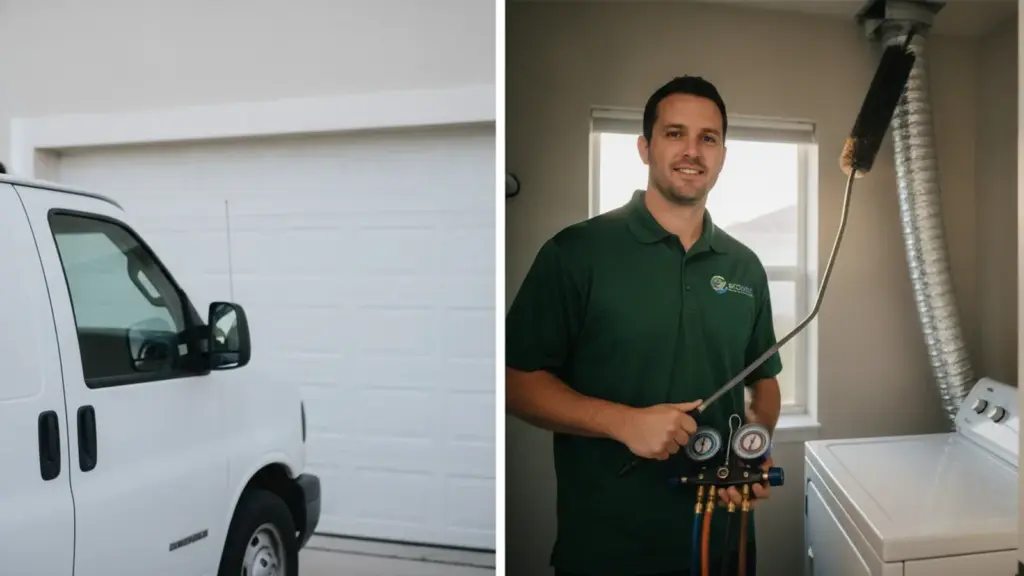
The St. Petersburg Condo Owner’s Guide to Dryer Vent Cleaning
Dryer vent cleaning in a single-family home is straightforward. In a St. Petersburg condo or multi-family building, it’s a different job entirely. Long duct runs, shared vertical chases, in-line booster fans, and HOA maintenance rules all change what the process looks like, who is responsible for it, and how often it needs to happen. If you’ve been putting this off because you weren’t sure where to start, this guide walks you through everything you need to know.
Why Condo Dryer Vents Are a Different Animal
The Problem with Long Duct Runs
Most single-family homes have a dryer vent that travels six to fifteen feet before exhausting outside. In a mid-rise or high-rise condo building in St. Petersburg, that same duct might travel forty, sixty, or even eighty feet, often bending through multiple floors before reaching a rooftop or exterior wall termination. Physics works against you here. The longer the duct run, the more resistance the dryer’s exhaust fan has to overcome, and the more lint accumulates along the way, especially at every elbow and horizontal section.
St. Petersburg’s coastal humidity compounds this. Moist Gulf air can mix with warm, lint-laden exhaust and cause lint to stick and compress against duct walls rather than blow cleanly through. What might take twelve to eighteen months to become a serious restriction in a dry inland climate can develop noticeably faster in Pinellas County’s humid environment.
In-Line Booster Fans: Helpful Until They’re Not
Many multi-family buildings install in-line booster fans partway through a long duct run to compensate for the added resistance. These fans are a legitimate engineering solution, but they introduce a maintenance variable that most residents never think about. Lint accumulates on the fan blades and housing. Over time, that buildup reduces the booster’s effectiveness, generates heat, and can eventually cause the motor to overheat or fail. A dryer duct cleaning that doesn’t address the booster fan interior is an incomplete job.
When Ecovent Dryer Duct Solutions services a condo duct system, the booster fan housing is inspected and cleaned as part of the process, not treated as an optional add-on. The fan blades, motor housing, and the duct sections immediately upstream and downstream all collect lint and need attention.
Shared Chases and Neighbor Impact
Some older St. Petersburg multi-family buildings route individual unit vents into a shared vertical chase. This design is now generally discouraged by current building standards because a blockage or fire in one unit’s duct can affect neighbors. If your building uses this configuration, it’s worth confirming with your property manager whether the shared sections are being maintained, and by whom. Individual unit owners typically cannot access the shared portion of the chase themselves.
HOA Rules and Maintenance Responsibility: What’s Usually Yours
Reading Your CC&Rs and Bylaws
Condo associations in Florida vary widely in how they allocate maintenance responsibility for dryer vents. Some associations treat everything from the dryer connection point outward as a common element, meaning the HOA schedules and pays for cleaning. Others draw the line at the unit boundary, leaving each owner responsible for the duct run within their walls. A few associations require owners to clean their own vents on a set schedule and provide documentation on request.
Before scheduling service, pull out your CC&Rs (Covenants, Conditions, and Restrictions) and bylaws and look specifically for language about dryer vents, exhaust ducts, or HVAC maintenance. If the language is ambiguous, a quick email to your property manager asking for clarification in writing protects you later.
When the HOA Schedules Building-Wide Cleaning
Some well-managed associations in St. Petersburg coordinate building-wide dryer duct cleaning on an annual or biannual basis. If yours does, confirm what the scope actually covers. Building-wide programs sometimes focus only on the common duct sections or the exterior termination, leaving the flexible transition hose and the first several feet of rigid duct inside your unit untouched. That section still accumulates lint and still needs attention.
If your association’s program has gaps, scheduling individual unit service to fill those gaps is straightforward. A technician can focus specifically on the sections not covered by the building’s contract.
Getting the Association to Act
If you’ve noticed warning signs (longer drying times, a hot dryer cabinet, a burning smell, or excessive heat near the exterior termination) and your association hasn’t scheduled maintenance, you have a few practical options. First, document the symptoms in writing and submit a formal maintenance request to your property manager. Second, reference your state’s fire code requirements as context. Florida’s fire prevention code incorporates NFPA 211 standards, which address dryer exhaust duct maintenance, though specific requirements vary by building type and occupancy. Framing your request around code compliance tends to move faster than framing it around personal preference.
Signs Your Condo Dryer Vent Needs Cleaning Now
The warning signs in a condo are the same as in any home, but they can be easier to dismiss because residents often assume the building is handling it. Watch for these:
- Clothes take more than one cycle to dry. A full load of towels or jeans that used to finish in forty-five minutes now takes ninety or requires a second cycle. Restricted airflow is the most common reason.
- The dryer cabinet feels unusually hot. Run your hand along the top and sides of the dryer mid-cycle. Excess heat that can’t exhaust properly radiates back into the machine.
- The laundry room smells musty or like burning lint. A faint burning odor during operation is a signal to stop using the dryer and have the duct inspected promptly.
- The exterior vent flap barely opens during operation. If you can access the exterior termination (or ask a neighbor on the same side of the building), a flap that stays mostly closed during a drying cycle indicates very low airflow.
- Excessive lint on clothes after drying. When airflow is restricted, lint that would normally exhaust out gets redeposited on fabrics.
- The booster fan cycles on and off or sounds labored. If your unit has an accessible booster fan, unusual sounds or cycling behavior often indicate lint accumulation on the blades.
What the Cleaning Process Actually Looks Like in a Multi-Family Building
Access Points and Inspection First
A proper service call starts with understanding the full duct path before any cleaning begins. For a condo unit, that means identifying where the duct enters the wall, how far it runs, whether there’s a booster fan and where it’s located, and where the duct terminates. In some St. Petersburg buildings, the technician can trace this from the unit alone. In others, coordination with building management is needed to access mechanical rooms or rooftop terminations.
A visual inspection, sometimes aided by a small camera for longer runs, reveals the actual condition of the duct interior, whether any sections have separated or collapsed, and where the heaviest lint accumulation sits. Skipping this step and going straight to brushing is how problems get missed.
Cleaning the Full Run, Including the Booster
The actual cleaning uses a combination of rotary brush systems and high-powered vacuum extraction. For long duct runs common in multi-family buildings, the technician works in sections, often from both the dryer end and the exterior termination end, to ensure the full length is addressed. Lint that breaks free needs to be captured, not just pushed further down the duct.
The booster fan housing is disassembled (or accessed through its service panel) and cleaned separately. The fan blades, housing interior, and the duct connections at both ports are cleared of lint accumulation. The technician then reassembles the unit and verifies it operates correctly before finishing.
Verification and Airflow Testing
The job isn’t done when the brushing stops. A technician should verify airflow at the termination point, confirm the exterior flap opens fully during operation, and check that the dryer itself is heating and cycling normally. Some technicians use an anemometer to measure airflow velocity and compare it against the dryer manufacturer’s specifications. If the duct run is very long, even a clean duct may not meet the dryer’s airflow requirements, which is useful information for deciding whether a booster fan needs to be added or upgraded.
Comparison: Single-Family vs. Multi-Family Dryer Vent Service
| Factor | Single-Family Home | Condo / Multi-Family Unit |
|---|---|---|
| Typical duct length | 6 to 20 feet | 20 to 80+ feet |
| Booster fan present | Rarely | Common on longer runs |
| Exterior access | Usually ground level, owner accessible | Often rooftop or upper-floor wall, requires coordination |
| Maintenance responsibility | Homeowner | Split between owner and HOA (varies by CC&Rs) |
| Recommended cleaning frequency | Annually for typical use | Annually to every 6 months depending on run length and use |
| Risk if neglected | Fire hazard, appliance wear | Same, plus potential impact on neighboring units |
| Complexity of service call | Lower, usually one technician | Higher, may require building coordination and multiple access points |
How Often Should a Condo Dryer Vent Be Cleaned in St. Petersburg?
Frequency Depends on Run Length and Usage
Annual cleaning is a reasonable baseline for most households. For condo units with duct runs exceeding forty feet, or for units where the dryer runs frequently (large families, home-based businesses that launder frequently), every six to nine months is more appropriate. The reasoning is simple: a longer duct holds more lint, and a restricted longer duct creates more back-pressure on the dryer, accelerating wear.
St. Petersburg’s humidity is a legitimate local factor. Gulf Coast moisture causes lint to compact more densely than it would in a drier climate, which means a six-month-old duct in Pinellas County may look more like a twelve-month-old duct elsewhere. If your previous cleaning was more than a year ago and you’ve noticed any of the warning signs listed above, schedule an inspection rather than waiting for the calendar to turn.
After Any Major Change to the System
Any time the duct system is modified, including a new dryer installation, a duct reroute, or booster fan replacement, the full run should be inspected and cleaned before regular use resumes. Construction debris, connector tape residue, and displaced lint from the installation process can create an immediate restriction. This is also a good time to confirm the new configuration meets current standards for duct material (rigid metal is preferred over flexible foil or plastic), maximum run length, and proper termination.
Practical Tips for St. Petersburg Condo Owners
Keep a Maintenance Log
Some associations require proof of dryer vent cleaning, particularly after a fire inspection or before a unit sale. Keep a copy of every service receipt, including the date, the technician’s name, and what was done. This takes thirty seconds and can resolve disputes with an association or a buyer’s inspector quickly.
Clean the Lint Trap Every Single Load
This is basic but worth stating plainly. A clean lint trap reduces the amount of lint that enters the duct system in the first place. In a building with a long duct run, anything that reduces lint load at the source extends the interval between professional cleanings. Check the lint trap screen periodically for residue buildup from dryer sheets; a screen clogged with waxy residue restricts airflow even when it looks clean. Wash it with warm water and a soft brush occasionally.
Know Where Your Duct Terminates
Many condo residents have no idea where their dryer duct exits the building. Ask your property manager or check the building’s as-built drawings if available. Knowing the termination location lets you (or a neighbor) do a quick visual check: is the flap opening during operation? Is there visible lint accumulation around the exterior cap? Is vegetation or a bird nest blocking the opening? These are things you can observe without any special tools and flag to a technician before a service visit.
Frequently Asked Questions
Can I clean my condo dryer vent myself?
For the short flexible transition hose between the dryer and the wall connection, a basic brush kit and vacuum can help maintain cleanliness between professional visits. The rigid duct run inside the wall, especially anything longer than ten feet or involving a booster fan, requires professional equipment and access. Attempting to clean a long duct run with a consumer brush kit often pushes lint further into the system rather than removing it.
My HOA says they handle dryer vent maintenance. Do I still need to do anything?
Confirm in writing what the HOA program actually covers. Many building-wide programs address only the common duct sections or exterior terminations. The duct section within your unit walls and the transition hose are frequently excluded. Ask specifically whether the booster fan (if present) is included in the building’s scope, and request documentation of the last service date.
How do I know if my building has a booster fan?
Check the laundry area for a small rectangular or cylindrical device mounted on the wall or ceiling, usually with two duct connections and an electrical cord. Some are installed inside walls and only audible during dryer operation as a secondary hum. Your building’s property manager or maintenance staff should have records of installed equipment. A technician performing a duct inspection can also identify whether one is present.
Is a burning smell from my dryer always an emergency?
Treat it as one until you know otherwise. Stop using the dryer, unplug it if safe to do so, and contact a professional for an inspection before running another cycle. A burning smell can indicate lint accumulation near the heating element, a failing motor, or a duct restriction that’s causing heat to build up inside the machine. None of these should be ignored or tested with another load.
Does Florida have specific rules about dryer vent maintenance in condos?
Florida’s fire prevention code references NFPA 211 for dryer exhaust duct maintenance, but specific requirements vary by building type, occupancy classification, and local amendments adopted by the City of St. Petersburg or Pinellas County. Requirements also vary based on whether the building is governed as a condominium, apartment complex, or cooperative. For authoritative guidance on your specific building, consult your property manager, a licensed contractor, or your local fire marshal’s office rather than relying on a general interpretation.
Getting the Right Help in St. Petersburg
Ecovent Dryer Duct Solutions works with condo owners and property managers across St. Petersburg and the broader Pinellas County area. Multi-family duct systems require a different approach than a standard residential call, and the team is experienced with long duct runs, in-line booster fan cleaning, building coordination, and the documentation that associations often require. If you’re unsure about the condition of your duct system or need to navigate HOA requirements, schedule a professional dryer vent inspection to get a clear picture of what you’re working with before the next drying cycle.
Ready to stop guessing and get it done right? book your dryer vent cleaning with Ecovent Dryer Duct Solutions and let a local expert handle the full run, booster fan included.