
The Complete Guide to Clothes Dryer Vent Cleaning for St. Petersburg Homeowners
Your dryer takes longer than it used to. Clothes come out warm but still damp. The laundry room feels stuffy after a cycle. These are not random appliance quirks, they are the classic signals of a clogged dryer vent, and in St. Petersburg’s humid climate, lint accumulates faster than most homeowners expect. This guide covers everything you need to know: why the vent clogs, what a professional cleaning actually involves, and how to know when it is time to call Ecovent Dryer Duct Solutions.
Why Dryer Vent Cleaning Matters More Than You Think
The Lint-and-Moisture Problem Unique to St. Petersburg
Florida’s Gulf Coast humidity does something that colder, drier climates do not: it makes lint sticky. When warm, moisture-laden exhaust air travels through a duct, it carries fine fiber particles from every load of laundry. In a dry climate those particles stay loose and blow through easily. In St. Petersburg’s humid air, they tend to cling to duct walls, compress into dense mats, and build up faster than the annual-cleaning rule of thumb suggests.
Homes with longer duct runs, multiple elbows, or flexible foil transition hoses accumulate lint even faster. The duct is essentially a long tunnel that lint is trying to escape through, and every bend or rough interior surface slows it down. Over time, what started as a thin coating becomes a serious restriction.
Fire Risk: The Reason the CPSC and NFPA Track This
Lint is highly combustible. The NFPA (National Fire Protection Association) consistently identifies dryers and washing machines as a leading source of home structure fires, with failure to clean the vent listed as the leading contributing factor. That is not a scare tactic, it is the documented pattern that drives fire departments and insurance companies to ask homeowners about dryer vent maintenance.
The ignition sequence is straightforward: restricted airflow causes the dryer to run hotter, heat builds up in the duct, and a spark or sustained high temperature can ignite the accumulated lint. A clean vent removes that fuel load from the equation. professional dryer vent cleaning is one of the most direct ways to reduce that risk in a residential setting.
Appliance Efficiency and Lifespan
A dryer working against a clogged duct runs longer to dry the same load. That extra run time translates directly to higher energy use and accelerated wear on the heating element, motor, and drum bearings. Technicians who repair dryers frequently find that machines brought in for heating failures or motor burnout have severely restricted venting. Keeping the duct clear is, in a real sense, part of maintaining the appliance itself.
Warning Signs Your Dryer Vent Needs Attention Now
Performance Red Flags
The most reliable early indicator is drying time. A standard residential load of mixed laundry should dry in roughly 45 to 60 minutes on a mid-heat setting. If you are regularly running two cycles to dry one load, the vent is the first thing to investigate, not the heating element, not the thermostat.
Other performance signals include:
- Clothes that feel hotter than usual at the end of a cycle (heat is not exhausting properly)
- The dryer exterior or the area around the exhaust hood feeling unusually warm
- A burning or musty smell during or after a cycle
- The laundry room becoming noticeably humid when the dryer runs
- The dryer shutting off mid-cycle (many modern machines have thermal overload protection that trips when internal temps spike)
Physical Clues at the Exterior Vent Hood
Walk outside and find the exhaust termination point on your home’s exterior wall or roof. While the dryer is running, the damper flaps should open and you should feel a strong, steady airflow. Weak airflow, flaps that barely move, or visible lint packed around the hood opening all point to a duct that needs cleaning. A bird or pest nest inside the termination cap is also more common in St. Petersburg than many homeowners realize, the warmth and shelter are attractive to small birds and wasps.
The Lint Trap Is Not the Whole Story
Many people assume that cleaning the lint screen after every load is sufficient. It is necessary, but it only captures a portion of the fiber that leaves the drum. Fine particles pass through the screen and travel into the duct system. Over months and years, those particles accumulate in the transition hose, the rigid duct sections, and especially at elbows. Cleaning the screen is maintenance; cleaning the duct is a separate, periodic service.
What a Professional Dryer Duct Cleaning Actually Involves
The Pre-Cleaning Inspection
A thorough service starts before any equipment comes out. The technician checks the duct routing, measures the run length, identifies the number and type of elbows, and confirms the termination point. In St. Petersburg homes, particularly older bungalows and ranch-style houses in neighborhoods like Kenwood or Disston Heights, duct routing can be unconventional. Some runs travel through interior walls, under floors, or up through attic spaces. Knowing the layout determines which tools and techniques apply.
The technician also inspects the transition hose (the flexible section connecting the dryer to the wall) and the exterior hood. Foil accordion-style hoses are a common problem: they trap lint in their accordion folds and are no longer recommended by most appliance manufacturers. If yours is still in place, replacing it with a smooth-wall metal transition hose is typically recommended at this stage.
The Cleaning Process Step by Step
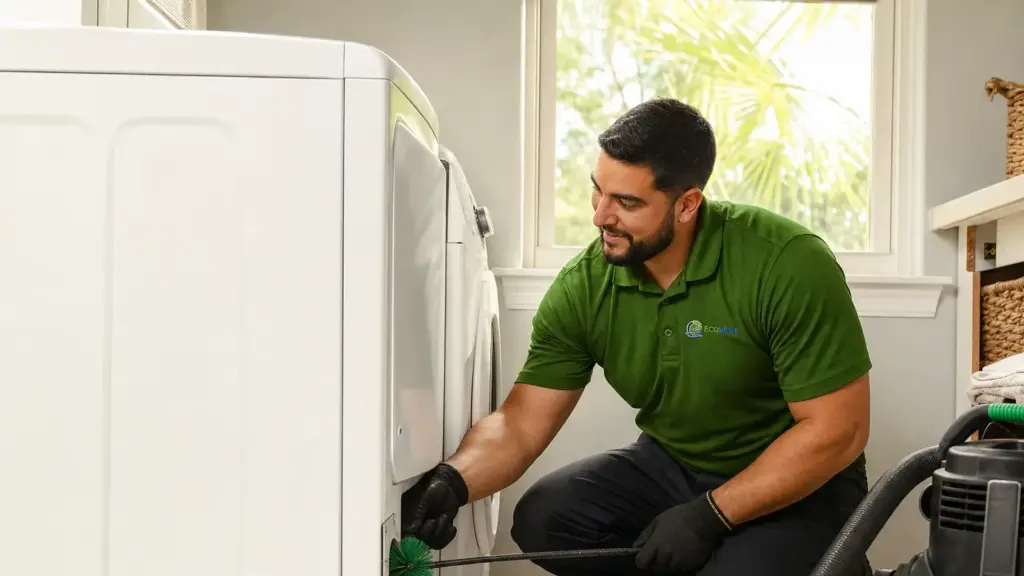
Professional dryer duct cleaning uses a combination of rotary brush systems and high-powered vacuum equipment. Here is the general sequence:
- Disconnect and access: The dryer is pulled away from the wall. The transition hose is disconnected from the wall collar.
- Vacuum attachment: A high-capacity vacuum is connected to the duct opening to capture debris as it is dislodged, preventing lint from being pushed into the room.
- Rotary brushing: A flexible rod system with a rotating brush head is fed through the duct. The brush agitates compacted lint from the duct walls while the vacuum pulls it toward the collection point. Rod sections are added as the technician works through the run.
- Exterior termination clearing: The hood and damper at the exterior are cleaned and inspected to confirm they open and close freely.
- Airflow verification: After reassembly, the dryer is run briefly and airflow at the exterior termination is checked. A noticeable improvement in flow volume confirms the duct is clear.
- Reconnection and documentation: The transition hose is reattached (or replaced if needed), the dryer is pushed back into position, and the technician reviews findings with the homeowner.
The entire process typically takes 45 minutes to 90 minutes depending on duct length and complexity. Longer runs with multiple elbows, or systems with booster fans, require more time.
What Happens With Long Runs or Booster Fans
Some St. Petersburg homes, especially multi-story townhomes or condos where the laundry is located far from an exterior wall, have dryer duct runs that exceed the maximum length recommended by appliance manufacturers. These longer runs may include a booster fan (an inline fan installed in the duct to maintain adequate airflow). Booster fans require their own cleaning and inspection, the fan housing and blades accumulate lint just like the duct walls. Ecovent Dryer Duct Solutions handles these systems as part of a standard service visit.
How Often Should St. Petersburg Homeowners Clean Their Dryer Vent?
The Standard Recommendation and When to Deviate From It
Most manufacturers and fire safety organizations recommend cleaning the dryer duct at least once per year. That is a reasonable baseline for a household doing four to five loads of laundry per week with a duct run under 25 feet and no more than two 90-degree elbows.
Several factors push the frequency higher:
| Factor | Recommended Frequency |
|---|---|
| Standard household (4-5 loads/week, short duct run) | Once per year |
| Large household (6+ loads/week) | Every 6-9 months |
| Pets in the home (pet hair accelerates lint buildup) | Every 6-9 months |
| Long duct run (30+ feet) or multiple elbows | Every 6-9 months |
| Flexible foil transition hose still in use | Every 6 months (and replace the hose) |
| Dryer used for a home business or rental unit | Every 3-6 months |
Seasonal Timing in St. Petersburg
There is no single “best” month for dryer vent cleaning in St. Petersburg the way there might be in a northern climate where you would schedule it before heating season. That said, many local homeowners find it convenient to schedule in late fall (October or November), when the busy holiday season is approaching and the dryer tends to get heavier use from thicker fabrics and more frequent laundry loads. Spring is another practical window, before summer humidity peaks and the dryer works harder against ambient moisture.
Dryer Vent Cleaning vs. Air Duct Cleaning: Not the Same Service
Different Systems, Different Processes
Homeowners sometimes conflate dryer duct cleaning with HVAC air duct cleaning. They are distinct services that address completely different systems. The dryer duct is a single dedicated exhaust duct that carries hot, lint-laden air from the dryer to the outside. HVAC air ducts are a branching network of supply and return passages that circulate conditioned air throughout the home.
The tools, techniques, and goals differ significantly. Dryer duct cleaning focuses on removing compacted lint and restoring exhaust airflow. air duct cleaning addresses the interior of HVAC ductwork, where dust, debris, and biological growth can accumulate over years of system operation. Both services matter, but they are not interchangeable, and scheduling one does not substitute for the other.
Can Both Be Done at the Same Visit?
Yes. Ecovent Dryer Duct Solutions in St. Petersburg offers both dryer vent cleaning and air duct cleaning services. Combining them in a single appointment is efficient and means the home is only disrupted once. If your HVAC ducts are overdue for attention, it is worth asking about scheduling both when you book.
Choosing a Dryer Vent Cleaning Service in St. Petersburg
Questions Worth Asking Before You Book
Not every service provider approaches the job the same way. Before scheduling, it is reasonable to ask:
- Do you inspect the full duct run before cleaning, or just the accessible sections?
- What equipment do you use? (Rotary brush systems with vacuum capture are the industry standard.)
- Do you check and clear the exterior termination cap?
- Do you verify airflow after the cleaning is complete?
- Can you handle booster fans or long duct runs?
- Will you advise on transition hose replacement if the existing one is a foil accordion type?
A provider who can answer these clearly and specifically is demonstrating process knowledge, not just marketing language.
Red Flags to Watch For
Be cautious of quotes given without any information about duct length or configuration, the scope of the job genuinely varies, and a flat quote offered sight-unseen suggests the provider may not be doing a thorough assessment. Similarly, a service that does not include an airflow verification step at the end has no way to confirm the cleaning was effective.
Ask whether the technician will document findings and walk you through what was found. A good technician treats the visit as an inspection as much as a cleaning, and leaves you with a clear picture of the duct’s condition and any concerns to monitor.
Simple Homeowner Maintenance Between Professional Cleanings
What You Can Do Yourself
Professional cleaning handles the duct itself, but there are a few straightforward habits that help maintain performance between service visits:
- Clean the lint screen every single load. A clogged screen restricts airflow at the source and pushes more fine particles into the duct.
- Wash the lint screen periodically. Fabric softener residue can coat the screen mesh and reduce airflow even when the screen appears clean. Hold it under running water, if water pools instead of flowing through, wash it with a soft brush and mild soap, then let it dry completely before reinstalling.
- Check the exterior vent hood seasonally. Clear any visible lint, debris, or pest activity from around the damper flaps. Make sure the flaps open freely when the dryer runs.
- Keep the area behind the dryer clear. Avoid crushing or kinking the transition hose when pushing the dryer back against the wall.
What to Leave to a Professional
Duct cleaning beyond the first foot or two of accessible hose, any work involving the duct inside walls or the attic, booster fan maintenance, and exterior hood replacement all require proper tools and knowledge of the full system layout. Attempting to push a brush through a long duct run without vacuum capture simply redistributes lint rather than removing it. For anything beyond surface-level lint screen maintenance, a licensed professional is the right call.
Frequently Asked Questions
How long does a dryer vent cleaning take?
Most residential cleanings take between 45 minutes and 90 minutes. Longer duct runs, multiple elbows, or systems with inline booster fans add time. A technician can give a more accurate estimate once the duct routing is assessed.
Is it normal for the dryer to smell during or after cleaning?
A mild, dusty smell immediately after cleaning is normal as the duct settles and any remaining fine particles work their way out over the first few cycles. A burning smell during normal dryer operation, however, is a warning sign that warrants professional attention rather than a normal post-cleaning effect.
Can I clean the dryer vent myself?
Consumer dryer vent brush kits are available, and they can help with the first few feet of accessible duct. For full duct runs, especially those with multiple elbows or long lengths, consumer kits typically cannot reach the full run and lack the vacuum capture needed to prevent lint from being pushed back into the room or further into the duct. Professional equipment is more effective for a thorough cleaning.
What is the difference between the lint trap and the dryer vent?
The lint trap (or lint screen) is the removable filter inside the dryer door or on top of the machine that catches the bulk of fiber from each load. The dryer vent is the duct system that carries exhaust air from the dryer through the wall to the outside. Both need regular attention, but they are separate components requiring different types of maintenance.
Does dryer vent cleaning help with drying time?
Yes, often noticeably. Restricted airflow is one of the most common reasons dryers take multiple cycles to dry a single load. After a thorough cleaning, many homeowners find their dryer returns to single-cycle performance. If drying time does not improve after cleaning, the issue may be with the appliance itself rather than the duct.
How do I know if my dryer vent terminates correctly?
The duct should terminate at the exterior of the home through a rigid metal hood with damper flaps, not into an attic, crawl space, wall cavity, or garage. Terminating into an enclosed space creates a moisture and fire hazard. If you are unsure where your duct exits, a technician can trace the run during an inspection visit.
Conclusion
Dryer vent cleaning is one of those maintenance tasks that is easy to overlook until something goes wrong. For St. Petersburg homeowners, the combination of high laundry frequency, humid air, and varied home construction makes staying on top of it more important than the national average suggests. Ecovent Dryer Duct Solutions serves the St. Petersburg area with professional dryer duct and air duct cleaning, and the team can assess your specific duct configuration and get your system running safely and efficiently. Schedule your dryer vent cleaning with Ecovent today and stop guessing whether your duct is clear.