
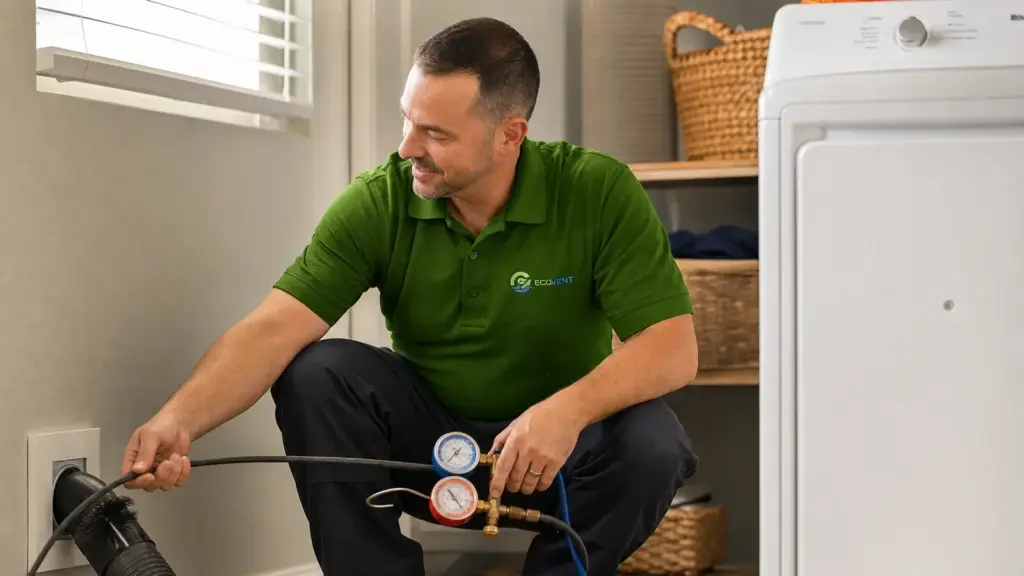
Dryer Vent Cleaning for Long Duct Runs and Booster Fans in St. Petersburg, FL
Most homeowners picture a short, straight duct running from the back of the dryer to an exterior wall. In St. Petersburg, that picture rarely matches reality. Older bungalows, stacked townhomes, and multi-story condos often force the vent path through long, winding routes that standard dryer airflow simply cannot handle alone. When lint starts building up faster than expected, or clothes take two cycles to dry, the duct run length is usually the first place to look, and a booster fan may already be part of the equation. This guide breaks down exactly how to evaluate your system and why professional dryer duct cleaning on these setups is more involved than a routine service call.
Why Long Duct Runs Are a Bigger Problem in St. Petersburg Than You Might Think
The Physics of Airflow Resistance
Every foot of duct adds friction resistance. Every elbow, whether a 45-degree or a 90-degree turn, adds the equivalent of several additional feet to the effective length. The industry standard for maximum equivalent duct length on a typical residential dryer is around 25 feet when using smooth rigid metal duct, and that number drops quickly once you start adding elbows. A single 90-degree elbow typically subtracts roughly 5 feet from your allowable run. Two or three elbows in a St. Petersburg townhome or condo can push you well past safe limits before the duct even reaches the exterior wall.
When airflow slows down, lint does not travel to the outside. It settles inside the duct. Over time, that settled lint restricts airflow further, which causes lint to settle even faster. It becomes a self-reinforcing cycle that ends in either a fire hazard or a dryer that simply stops performing.
How St. Petersburg’s Building Stock Creates the Problem
The city’s housing mix, ranging from 1920s bungalows with interior utility closets to newer high-rise condos where the laundry room is nowhere near an exterior wall, creates vent routing challenges that are genuinely uncommon in newer suburban construction. Many homes here were built before clothes dryers were standard appliances, so the ductwork was retrofitted through whatever path was available: up through the attic, across a long interior wall, or down through a crawl space before exiting at the foundation. Each of those paths adds length and elbows. Ecovent Dryer Duct Solutions sees this configuration regularly across St. Petersburg, and it requires a different approach than a simple brush-and-blow service.
When the Run Is Too Long to Clean Effectively from One End
On a run longer than about 20 feet, a technician working from the dryer end alone may not be able to dislodge lint packed near the exterior termination cap, and vice versa. Effective dryer duct cleaning on long runs typically requires working from both ends, using flexible rod systems long enough to reach the midpoint from each direction, and confirming airflow with a pressure or airflow gauge after the work is done. Without that confirmation step, you cannot know whether the duct is truly clear or just clear near the access point.
Booster Fans: The Solution That Creates Its Own Maintenance Requirement
What a Booster Fan Actually Does
An inline dryer duct booster fan is an electrically powered fan installed somewhere along the duct run, usually midway or near the exterior, to supplement the dryer’s own blower. It activates automatically when it senses airflow, helping push moist, lint-laden air the full distance to the outside. For runs that genuinely exceed safe equivalent length limits, a properly specified and installed booster fan can make an otherwise non-compliant system function safely.
The key word is “properly.” A booster fan installed in the wrong location, or one that is undersized for the duct diameter and run length, can actually create a low-pressure zone in the duct that causes lint to drop out of suspension faster. That is the opposite of what you want.
The Lint Trap Inside Your Booster Fan
Here is something many homeowners do not realize until they have a problem: the booster fan housing itself collects lint. The fan blades, the motor housing, and the interior surfaces of the fan body all accumulate the same fibrous debris that builds up in the duct walls. In some configurations, the fan housing collects lint faster than any other section of the duct because airflow turbulence around the blades causes lint to fall out of suspension.
A standard dryer duct cleaning service that does not specifically address the booster fan leaves a significant lint deposit in place. Ecovent Dryer Duct Solutions treats the booster fan as a separate cleaning task, not an afterthought, because the fan body often holds more accumulated lint than the surrounding duct sections combined.
Signs Your Booster Fan Needs Attention Now
You do not always need a technician to tell you something is wrong. Watch for these indicators:
- Clothes take noticeably longer to dry than they did six months ago, even with a clean lint trap.
- The exterior vent flap barely moves when the dryer runs, suggesting reduced airflow.
- The dryer itself runs hotter than usual, or the laundry room feels warmer and more humid during a cycle.
- You can hear the booster fan motor running but the airflow at the exterior cap feels weak.
- The booster fan runs continuously even after the dryer stops, which can indicate a sensor or relay issue caused by lint interference.
Any one of these symptoms on a system with a long duct run warrants a professional evaluation, not just a filter change.
Evaluating Your System Before Scheduling a Cleaning
Mapping the Actual Duct Path
Before a technician can clean a long-run system properly, someone needs to know exactly where the duct goes. This sounds obvious, but in many St. Petersburg homes the duct path is partially hidden inside walls, above drop ceilings, or in attic spaces that were never intended to be accessed. A good evaluation starts with tracing the visible sections, identifying access points, and estimating the total equivalent length including all elbows and transitions.
If the duct passes through an unconditioned attic space, that section also warrants a check for disconnected joints. Attic heat in St. Petersburg is intense for most of the year, and flexible foil duct (which should not be used at all in a dryer vent, but sometimes is) degrades quickly in those conditions, creating gaps where lint escapes into the attic insulation.
Checking the Duct Material
Rigid smooth-wall metal duct is the correct material for a dryer vent. Semi-rigid aluminum is acceptable in short transition sections. Flexible plastic or foil duct is not appropriate for dryer exhaust regardless of run length, because it cannot withstand the heat, it sags and collects lint in the low points, and it is a known fire risk. If any section of your long run uses flexible plastic duct, that section should be replaced before a cleaning even takes place, because pushing a brush through degraded flexible material can tear it open inside the wall or ceiling cavity.
When Ecovent Dryer Duct Solutions evaluates a long-run system in St. Petersburg, checking the duct material is part of the pre-cleaning assessment, not something discovered mid-job.
Assessing the Exterior Termination Cap
The termination cap at the end of the run is the last line of defense against birds, insects, and rain intrusion, and it is also one of the most common points of lint blockage. Louvered caps with multiple small flaps restrict airflow more than a single-flap cap, and they collect lint on the louvers themselves. On a long run where airflow is already marginal, a partially blocked termination cap can push the system past its functional limit.
The cap should open fully when the dryer runs and close completely when it stops. If it is stuck partially open, pests can enter. If it is stuck partially closed, airflow suffers. Either condition needs to be corrected as part of a complete clothes dryer vent cleaning service.
The Cleaning Process for Long-Run Systems: What Is Different
Equipment That Reaches the Full Length
Standard residential dryer vent cleaning kits sold at hardware stores typically include rods that connect end-to-end up to about 12 feet. That is not enough for a 30-foot run. Professional equipment uses longer, more rigid rod systems that can reach 30 to 40 feet from a single access point, combined with high-powered vacuum equipment that creates enough negative pressure to capture dislodged lint rather than letting it fall deeper into the duct.
If you want it handled correctly the first time, consider professional breathe easy with professional dryer vent cleaning in Petersburg 33709.
On runs where the duct passes through an inaccessible wall section, working from both the dryer connection and the exterior cap simultaneously, with one technician on each end, is often the only way to confirm the full length is clear.
Cleaning the Booster Fan Housing
Accessing the booster fan for cleaning requires locating it, which is not always straightforward when it is installed inside a wall cavity or above a drop ceiling. Many fan models have a removable access panel; others require the duct to be partially disconnected to reach the fan body. The blades need to be cleaned of lint buildup, and the interior housing surfaces need to be wiped or vacuumed clear. After reassembly, the fan’s automatic activation sensor should be tested to confirm it triggers correctly when airflow begins.
This is the step that most generic cleaning services skip, either because they do not know the fan is there or because accessing it takes additional time. Skipping it leaves a lint deposit that can reignite buildup in the duct within months of a cleaning.
Post-Cleaning Airflow Verification
The job is not finished when the rods come out. A proper long-run cleaning ends with an airflow measurement at the exterior cap while the dryer runs. This confirms that the duct is clear, the booster fan is functioning, and the termination cap is opening fully. Without this step, a technician cannot honestly tell you the system is performing correctly. Ecovent Dryer Duct Solutions includes this verification as a standard part of the service on long-run systems in St. Petersburg.
Long-Run Duct Cleaning vs. Standard Cleaning: A Quick Comparison
| Factor | Standard Short Run (under 20 ft) | Long Run with Booster Fan (20+ ft) |
|---|---|---|
| Access points needed | Usually one (dryer end) | Often two (dryer end + exterior cap) |
| Equipment required | Standard rod kit + vacuum | Extended rod system + high-capacity vacuum |
| Booster fan cleaning | Not applicable | Required as a separate task |
| Post-cleaning verification | Visual check at vent cap | Airflow measurement at exterior cap |
| Duct material inspection | Quick visual | Full-path assessment including hidden sections |
| Recommended cleaning frequency | Annually for most households | Every 6-12 months depending on usage and lint load |
Booster Fan Maintenance Between Professional Cleanings
What Homeowners Can Safely Do
Between professional dryer duct cleaning visits, there are a few things you can do yourself without any tools or risk. First, check the exterior termination cap monthly. Look through the flap to see if lint is visible on the interior surface of the cap. A small amount is normal; a visible mat of lint means airflow has already slowed enough to cause deposition, and a professional cleaning should move up on the schedule.
Second, pay attention to your dryer’s performance. A single load of towels should dry fully in one standard cycle. If it does not, that is a more reliable early-warning indicator than any visual check. Keep a loose mental note of how long cycles are taking, and flag any trend toward longer drying times.
Third, confirm the booster fan activates when the dryer starts. You should be able to hear it running if you stand near the section of wall or ceiling where it is installed. If the dryer runs and the fan does not, the activation sensor may have failed, and the system is effectively operating without its supplemental airflow assist.
When to Call for a Professional Evaluation
Schedule a professional evaluation if you notice any of the warning signs listed earlier, if it has been more than 12 months since the last cleaning, or if you have recently moved into a St. Petersburg home and do not know the history of the vent system. A home inspection report rarely includes a detailed dryer duct assessment, so buying a home with a long-run system means inheriting an unknown maintenance history.
If you are unsure whether your duct run qualifies as “long” by the standards described here, a technician can measure the equivalent length during an initial evaluation. That assessment takes only a few minutes and gives you a clear answer about whether your system needs standard or extended-run service. You can schedule a dryer vent evaluation with Ecovent Dryer Duct Solutions to get that answer before a problem develops.
Frequently Asked Questions
How do I know if my dryer vent run is too long?
The most reliable way is to trace the full duct path and calculate the equivalent length, adding roughly 5 feet for each 90-degree elbow and 2.5 feet for each 45-degree elbow. If the total exceeds the dryer manufacturer’s maximum (often around 25 feet for smooth rigid duct), the run is too long for the dryer’s blower alone and a booster fan or duct rerouting should be considered.
Can I install a booster fan myself?
The fan itself is not a high-voltage or gas appliance, but placement matters significantly. An incorrectly positioned fan can worsen lint accumulation rather than prevent it. It also needs to be wired to activate automatically with the dryer’s airflow. Unless you are comfortable with both duct work and basic electrical connections, having a professional handle the installation and placement assessment is the safer choice.
How often should a long-run dryer duct system be cleaned?
For most households with a long run and a booster fan, every 6 to 12 months is a reasonable target. Households that do more laundry than average, or that dry heavy items like towels and bedding frequently, may need service closer to the 6-month end of that range. The best indicator is dryer performance: if drying times are creeping up, do not wait for the annual appointment.
What happens if the booster fan is not cleaned during a duct cleaning?
Lint left in the fan housing can partially block the fan blades, reducing the supplemental airflow the fan provides. It can also create a warm, fibrous environment that accelerates lint accumulation in the duct sections immediately downstream of the fan. Over time, a dirty fan housing can become a fire risk independent of the duct itself.
Is flexible foil duct ever acceptable for a dryer vent?
Only in the short transition section between the dryer’s exhaust port and the rigid duct, and only if it is the semi-rigid aluminum type, not the thin plastic accordion style. The rest of the duct run should be rigid smooth-wall metal. If you have flexible foil or plastic duct running through a wall or ceiling cavity, replacing it with rigid duct should be a priority before the next cleaning.
Does Ecovent Dryer Duct Solutions service condos and townhomes in St. Petersburg with shared duct systems?
Yes. Multi-unit buildings often have the most complex duct routing, and some older St. Petersburg condos have shared or stacked vent configurations that require coordination with building management. An on-site evaluation is the best starting point to understand what the system looks like and what cleaning approach is appropriate.
Conclusion
Long dryer duct runs and booster fans are not a niche problem in St. Petersburg. They are a common reality in the city’s older housing stock and multi-unit buildings, and they require a level of service that goes beyond what a standard cleaning covers. Understanding your duct path, the condition of the booster fan, and the material used throughout the run is the foundation of a system that performs safely and efficiently. If you have any reason to think your vent run is longer than average, or if your booster fan has never been cleaned as part of a professional service, now is the right time to get a clear picture of what you are working with. Contact Ecovent Dryer Duct Solutions to book your long-run dryer vent inspection and get a complete assessment from a team that knows St. Petersburg’s homes inside and out.