
How to Maintain Dryer Vent Efficiency After a Clean in St. Petersburg, FL
You pull a load of towels from the dryer and they’re still damp after a full cycle. The drum is warm, the machine ran its full time, but something is off. If you live in St. Petersburg, that feeling is more common than you might think. The city’s persistent coastal humidity means lint absorbs moisture, compacts faster, and clings to duct walls more stubbornly than it does in drier climates. A professional cleaning restores airflow, but what happens in the months between service visits determines how long that efficiency actually lasts.
This guide walks you through the specific dryer vent maintenance habits that matter most for St. Pete homes, from the quick checks you can do weekly to the seasonal inspections that catch problems before they become serious. When it is time to book your next professional service, the criteria covered in our guide to choosing a reliable dryer vent cleaning service will help you pick the right provider.
Before You Start: What You’ll Need
- A soft-bristle lint brush (flexible, at least 12 inches long)
- A vacuum with a narrow crevice attachment
- A flashlight or phone torch
- A screwdriver (for removing the vent cover at the exterior wall)
- Mild dish soap and a damp cloth (for the lint trap housing)
- Replacement foil-tape if you notice any disconnected or sagging duct sections (rigid metal tape, not standard duct tape)
- A notepad or phone to log what you observe each time
You do not need any special certifications or power tools for the routine steps below. If any step reveals a crushed duct, a disconnected section inside the wall, or a vent that exits through the roof rather than a side wall, stop and call a licensed professional. Those situations require equipment and training that go beyond safe homeowner maintenance.
Step 1: Clean the Lint Trap Before Every Single Load
This sounds obvious, but the lint trap is the first line of defense in the entire dryer vent system. In St. Petersburg’s humidity, lint that sits in the trap between loads can mat down and partially block airflow even before a cycle begins. Pull the trap out completely, peel the lint off in one sheet if possible, and dispose of it. Once a week, hold the screen up to a light source: if light passes through unevenly or barely at all, residue from dryer sheets has coated the mesh. Wash the screen with warm water, a drop of dish soap, and a soft brush, then let it dry fully before reinserting it. A coated screen can restrict airflow almost as much as a partially clogged duct.
Step 2: Vacuum the Lint Trap Housing Monthly
Lint that escapes the screen falls into the housing channel below. Use your vacuum’s crevice tool to reach as far down into that slot as possible. Follow with the flexible lint brush to dislodge anything the suction missed. In coastal Florida homes where the laundry room may not be air-conditioned, this channel can accumulate lint faster because warm, moist air slows the lint’s journey through the duct and causes more of it to drop and settle early. Spending three minutes on this step each month keeps the buildup from compounding.
Step 3: Inspect the Exterior Vent Cap Every 30 Days
Walk around to wherever your dryer vent exits the home, usually through a side wall or soffit, and look at the vent cap. It should have a flap or louver that opens when the dryer runs and closes when it is off. In St. Petersburg, two things commonly compromise these caps: salt air corrosion and pest intrusion. A flap that is stuck open invites moisture, insects, and even small lizards into the duct. A flap that is stuck closed backs up hot, lint-laden air into the duct. Gently press the flap with your finger to confirm it moves freely. If it is corroded, bent, or missing, replace it promptly. This is also a good moment to check that nothing has built a nest inside the cap opening, which is not uncommon in the warmer months here.
Step 4: Run a Timed Performance Check Quarterly
You do not need special instruments to gauge whether your vent is flowing well. Wash a standard load of similar-weight items (a set of bath towels works well), then run the dryer on a normal heat setting and note the time it takes to dry them fully. Write it down. Repeat this same test every three months with a comparable load. If drying time creeps up by 15 minutes or more compared to your baseline, restricted airflow is the most likely cause, even if you cannot see obvious lint buildup. This simple log gives you objective data rather than relying on memory, and it gives a technician useful context when you do schedule a service. For more on how St. Petersburg’s humidity accelerates lint accumulation specifically, see our related article on humidity and dryer lint buildup in St. Petersburg.
Step 5: Check the Duct Run for Kinks and Sags Twice a Year
If you want it handled correctly the first time, consider professional breathe easy with professional dryer vent cleaning in Petersburg 33709.
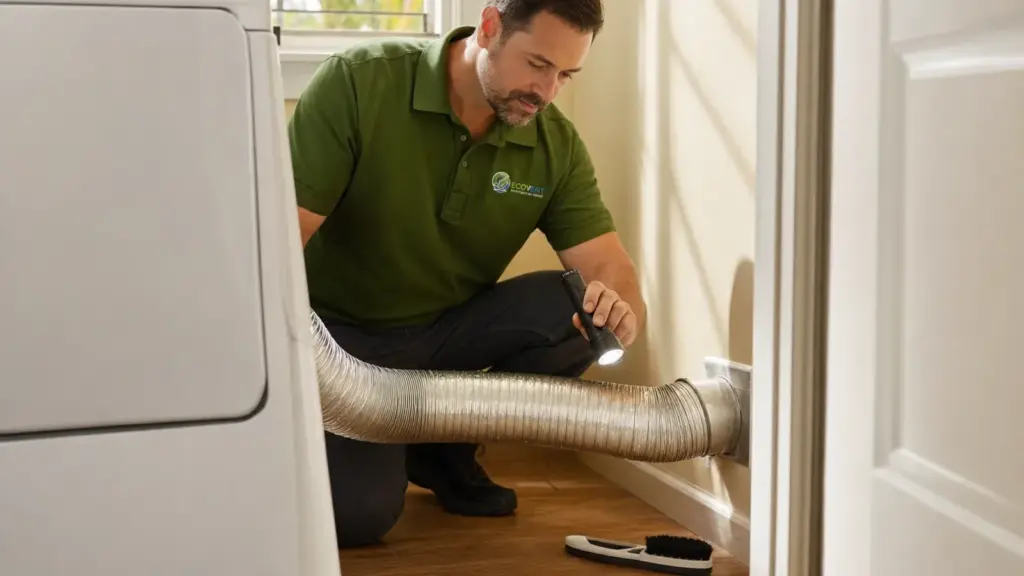
Pull your dryer away from the wall far enough to see the transition duct, the flexible section that connects the dryer’s exhaust port to the rigid duct in the wall. This section should have a gentle curve with no sharp kinks, no accordion-style compression, and no sections that sag toward the floor. A kinked or sagging transition duct traps lint at the low point and dramatically reduces airflow even when the rest of the system is clean. If the transition duct is made of white vinyl or foil-style accordion material, consider asking your technician about replacing it with a rigid or semi-rigid metal duct on the next professional visit. Rigid metal holds its shape, resists crushing, and is far easier to clean thoroughly.
While you have the dryer pulled out, shine your flashlight into the wall duct opening. You should see a clear, unobstructed path. Any visible lint accumulation at the opening is a sign that the interior duct walls need attention sooner rather than later.
Step 6: Verify Your Duct Length and Path Are Still Appropriate
St. Petersburg homes, particularly the older bungalows and block construction homes built through the mid-20th century, were not always designed with dryer venting in mind. When appliances were added or laundry rooms were relocated during renovations, duct runs sometimes ended up longer than recommended or included multiple 90-degree elbows that reduce effective airflow. Each 90-degree elbow is roughly equivalent to adding several feet of straight duct to the total run length. If your duct path includes more than two or three elbows, or if the total run is unusually long, the system will clog faster between professional cleanings regardless of how diligent your maintenance habits are. You do not need to measure this yourself, but it is worth asking your technician to assess the path on the next visit and confirm it falls within manufacturer and building-code guidelines for your specific dryer model. Requirements vary by area, so check with a licensed professional about what applies to your home.
Step 7: Watch for the Early Warning Signs That Mean a Professional Visit Is Needed Now
Even with consistent maintenance, certain signals mean you should schedule a professional cleaning rather than waiting for your next routine appointment. Contact a qualified dryer vent cleaning service if you notice any of the following:
- The dryer’s exterior surface feels unusually hot to the touch during or after a cycle
- A burning or musty smell comes from the dryer or laundry area while running
- The laundry room feels noticeably more humid than usual after a cycle, which suggests exhaust is not exiting the home properly
- Visible lint or debris around the exterior vent cap after a cycle
- The dryer shuts off mid-cycle due to overheating (most modern dryers have a thermal cutoff that triggers under restricted airflow)
- More than 12 months have passed since the last professional cleaning, regardless of how the dryer seems to be performing
Our article on signs your dryer vent is clogged in St. Petersburg goes deeper on each of these indicators and what they typically mean for the condition of the duct.
Step 8: Keep the Area Around the Dryer Clear
This step is easy to overlook because it does not involve the duct itself, but the space around your dryer affects how well the system performs. Dryers need adequate clearance at the rear for the transition duct to curve without kinking, and they need airflow around the cabinet to dissipate heat. Laundry rooms in St. Pete’s older homes are often compact, and it is tempting to stack storage boxes or push the machine flush against the wall. Resist both. Keep at least four inches of clearance behind the dryer, and do not store flammable items (extra lint rolls, cleaning products, cardboard boxes) in direct contact with the machine.
Step 9: Schedule Professional Cleaning on a Consistent Annual Cycle
Home maintenance habits extend the time between professional visits, but they do not replace them. The interior walls of a duct run collect a film of lint that a vacuum and brush cannot fully remove without professional-grade rotary equipment and the right extraction tools. In St. Petersburg, where humidity causes lint to bind more tightly to duct walls, an annual professional cleaning is a reasonable baseline for most households. Homes with multiple residents, pets that shed heavily, or dryers that run daily may benefit from a more frequent schedule.
Many Petersburg 33709 homeowners rely on expert breathe easy with professional dryer vent cleaning in Petersburg 33709 for exactly this.
When it is time to book, use the framework in our dryer vent cleaning service selection guide to evaluate providers on the right criteria: equipment used, whether they inspect the full duct run, and how they confirm airflow is restored before they leave. Understanding what a thorough job looks like helps you ask the right questions before you commit. If you are weighing whether to attempt a deeper cleaning yourself before calling a professional, the breakdown in our DIY vs. professional dryer vent cleaning comparison lays out exactly where the line is between safe homeowner work and tasks that require professional tools.
When to Call a Professional in St. Petersburg
St. Petersburg’s housing stock presents a few specific situations where professional intervention is particularly important rather than optional. Homes in the Kenwood, Old Northeast, and Shore Acres neighborhoods frequently have duct runs that exit through the roof rather than a side wall, a configuration that is significantly harder to keep clear and requires specialized equipment to clean safely. The city’s salt-air environment also accelerates corrosion on exterior vent hardware and metal duct connections, which means a professional inspection can catch deteriorating components before they fail.
If your home was built before the 1980s and the laundry room has never been updated, there is a reasonable chance the dryer venting was added as an afterthought with whatever materials were available at the time. Older flexible vinyl duct, in particular, is no longer considered an acceptable material for dryer venting because it sags, kinks, and can hold static electricity that attracts lint. A professional can assess whether your existing duct material and path are appropriate and flag anything that warrants replacement. Duct replacement is a separate service from cleaning, and knowing which one you actually need saves time and money.
Frequently Asked Questions
How often should I clean the lint trap if I run multiple loads per day?
Clean it between every load, not just once a day. Each load deposits a fresh layer of lint, and a partially blocked screen from the previous cycle reduces airflow for the next one. In high-use households, this habit makes a measurable difference in drying time and energy use.
Can I use a leaf blower to clear the duct from the exterior vent?
Blowing air backward through the duct from the outside can dislodge loose lint, but it pushes debris toward the dryer rather than extracting it. Lint that lands inside the dryer cabinet near the heating element creates a hazard. Leave duct clearing to professional equipment designed to extract debris out of the system entirely.
My dryer vent exits through the roof. Does that change my maintenance routine?
Yes. Roof-exit vents are harder to inspect visually and accumulate lint faster because the duct must run vertically for part of its path. The exterior cap is also more exposed to Florida’s sun and rain, which degrades it faster. Inspect the interior duct opening near the dryer more frequently, and plan on professional cleaning at least annually, possibly more often depending on usage.
Is the musty smell coming from my laundry room a vent problem?
It can be. When a dryer vent is partially blocked, moist exhaust air backs up into the laundry room instead of exiting the home. In St. Petersburg’s already-humid environment, that trapped moisture can contribute to a musty odor. If the smell appears or worsens when the dryer runs, restricted airflow is worth investigating before assuming the cause is something else.
How do I know if my duct is rigid metal or flexible vinyl without pulling the dryer out?
Pull the dryer out a few inches and shine a flashlight at the connection behind the machine. Rigid metal duct is smooth, silver, and holds a fixed shape. Flexible foil accordion duct is corrugated and collapses when not under tension. White or gray plastic-feeling material is vinyl, which is the type most worth flagging to a professional for evaluation.
Keeping Your Dryer Running Right in St. Pete
Dryer vent maintenance is one of those tasks that rewards consistency over intensity. A few minutes after each load, a monthly vacuum of the housing, a quarterly performance check, and a visual inspection of the exterior cap twice a year add up to a system that stays cleaner longer and gives you earlier warning when something needs attention.
For St. Petersburg homeowners specifically, the combination of coastal humidity, older housing stock, and sometimes unconventional duct configurations makes staying on top of these habits more important than it might be in a drier or newer market. When the maintenance steps above reveal something beyond routine upkeep, or when the annual cleaning window arrives, reach out to a qualified dryer vent cleaning professional who knows the local conditions and can assess the full system from dryer cabinet to exterior cap.