
DIY vs Professional Dryer Vent Cleaning in St. Petersburg, FL: A Homeowner’s Checklist
Most people assume a long brush kit from the hardware store does the same job as a professional service. It does not, and in Florida’s humid coastal climate that gap matters more than it does in drier states. St. Petersburg homes deal with lint that absorbs moisture, compacts tighter, and clings to duct walls in ways that a flexible rod and brush rarely fully address. This checklist walks you through exactly what each approach covers, where each falls short, and what to check before deciding.
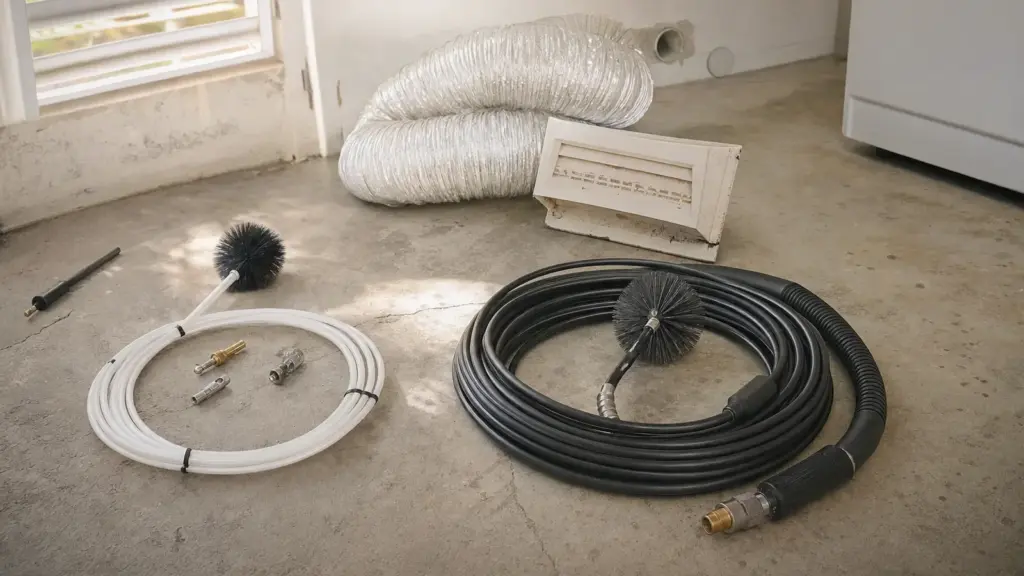
What a DIY Brush Kit Can Realistically Do
- Remove loose, dry lint from the first 1-3 feet of duct directly behind the dryer.
- Clear visible debris from the exterior vent hood if the run is short and straight.
- Confirm the exterior flap opens and closes freely during a quick visual check.
- Reconnect a flexible transition hose that has simply pulled loose from the wall collar.
- Replace a damaged plastic or foil accordion transition hose with a rigid metal section (a safe, code-preferred swap for the short segment behind the unit).
- Change the lint screen after every load, which is the single most effective homeowner maintenance step.
- Vacuum the lint trap housing with a narrow attachment to remove buildup the screen misses.
These tasks have real value. Keeping the transition hose clear and the trap housing clean reduces the load a professional service has to address, and extends the interval between full cleanings.
Where DIY Approaches Fall Short
- Brush rods flex and bow inside long or multi-elbow runs, pushing compacted lint further in rather than extracting it.
- Consumer kits generate no suction, so dislodged lint can settle deeper in the duct or blow back into the laundry area.
- Flexible rods cannot navigate 90-degree elbows without losing contact with the duct wall, leaving lint deposits at every bend.
- DIY tools cannot detect a crushed, kinked, or disconnected duct section hidden inside a wall or ceiling cavity.
- No consumer kit includes a camera or inspection scope to confirm the duct is clear end-to-end after cleaning.
- Moisture-laden lint common in coastal St. Petersburg homes forms dense clumps that resist brush agitation and require rotary or high-velocity equipment to break apart.
- Bird nests, wasp nests, or debris lodged at the exterior hood require removal before brushing, and forcing a brush through an obstruction can compact it further.
- Homeowners cannot safely access roof-terminated vents or vents routed through attic spaces without proper equipment and fall protection.
If you are noticing longer dry times or the dryer feels hot to the touch, those are signals that warrant a closer look. The checklist at signs your dryer vent is clogged in St. Petersburg covers the specific indicators worth watching for before deciding whether DIY maintenance is enough.
If you want it handled correctly the first time, consider professional breathe easy with professional dryer vent cleaning in Petersburg 33709.
What Professional Equipment Actually Does Differently
- High-powered rotary brush systems spin at controlled speeds, scrubbing the full interior circumference of the duct wall rather than just the center path.
- Simultaneously run negative pressure (vacuum) pulls dislodged lint toward the collection point rather than deeper into the system.
- Flexible rotary cable follows duct geometry through elbows and offsets without losing wall contact.
- Inspection cameras confirm the duct is clear from the dryer connection to the exterior termination point before the job is considered complete.
- Technicians check airflow velocity at the exterior hood with a measuring device, giving a before-and-after comparison rather than a visual estimate.
- Professionals identify and document crushed, kinked, or improperly connected duct sections that a brush cannot fix and that a homeowner cannot see.
- Exterior termination points are inspected for damaged flaps, pest screens (which NFPA 211 prohibits on dryer vents), and bird or insect nesting material.
- The technician can advise on duct material upgrades, such as replacing remaining flexible foil with rigid or semi-rigid metal, which reduces lint adhesion and is the preferred material per current installation standards.
When you are evaluating a dryer vent cleaning service in St. Petersburg, asking whether a company uses rotary extraction with simultaneous vacuum and performs a post-clean airflow check is one of the clearest ways to distinguish a thorough process from a surface-level one.
St. Petersburg-Specific Considerations for Dryer Vent Maintenance
- Tampa Bay’s high year-round humidity means lint inside the duct absorbs ambient moisture, compacting into a denser mass that resists simple brushing and accelerates blockage faster than in arid climates.
- Many St. Petersburg homes built from the 1950s through the 1980s were constructed before dryer vent routing standards were formalized; runs through interior walls, long horizontal stretches, and multiple elbows are common in these older floor plans.
- Coastal salt air accelerates corrosion on exterior vent hood hardware; aluminum or galvanized steel hoods should be checked annually for flap failure, which allows humid outside air (and pests) to enter the duct when the dryer is off.
- Florida’s warm temperatures keep insects and birds active year-round, making pest intrusion into exterior vent terminations a recurring issue rather than a seasonal one.
- Homes with tile roofs common in Pinellas County sometimes have dryer vents routed to roof terminations, which require ladder access and specific cap styles; these runs are not safe or practical for DIY cleaning.
- Air conditioning runs nearly continuously in St. Petersburg, which means laundry rooms stay cooler than the dryer exhaust, creating a condensation gradient inside the duct that encourages lint adhesion to duct walls.
- Local building requirements for duct length and elbow equivalency vary; if a duct run exceeds the manufacturer’s specified maximum equivalent length, a booster fan or rerouting may be needed. Requirements vary by jurisdiction, so confirming with a licensed professional is the right step rather than assuming a standard applies.
Understanding how St. Petersburg’s climate affects lint buildup is also covered in more depth at how humidity affects dryer lint buildup in St. Petersburg, which explains the specific mechanism behind moisture-compacted lint and why it matters for cleaning frequency.
Many Petersburg 33709 homeowners rely on expert breathe easy with professional dryer vent cleaning in Petersburg 33709 for exactly this.
Checklist: Deciding Which Approach Is Right for Your Situation
- Confirm your duct run length: if the total run (including elbow equivalents) exceeds roughly 25 feet, professional equipment is the practical choice for a full clean.
- Check the duct material: if any section is plastic accordion hose, that section should be replaced regardless of cleaning method, as plastic retains static and lint far more than metal.
- Count the elbows: each 90-degree elbow adds resistance and is a location where lint compacts; more than two elbows in a run makes full extraction with a consumer brush kit unlikely.
- Identify the termination point: if the vent exits through the roof, through a soffit, or through a wall more than one story up, professional access is required for safe cleaning.
- Assess dry time: if a full load takes more than one cycle to dry, the duct restriction has already progressed beyond what surface maintenance resolves.
- Check for pest activity: if you hear or see evidence of birds or insects at the exterior hood, clear the obstruction professionally before any cleaning attempt.
- Review cleaning history: if the duct has never been professionally cleaned or was last cleaned more than two years ago, a professional baseline clean is warranted before resuming DIY maintenance intervals.
- Inspect the exterior flap: if it does not open fully during dryer operation or does not close completely when the dryer is off, the hood needs service regardless of the duct’s condition.
If cost factors are part of your decision, what affects the cost of dryer vent cleaning outlines the variables that influence pricing, including duct length, material type, and access complexity, without any guesswork about specific figures.
Maintenance Tasks Homeowners Should Do Between Professional Cleanings
- Clean the lint screen before or after every single load, not just when it looks full.
- Vacuum the lint trap housing every one to three months using a narrow crevice tool to remove lint that bypasses the screen.
- Visually inspect the exterior vent flap monthly to confirm it opens during operation and closes fully at rest.
- Pull the dryer away from the wall every six months to check the transition hose for kinks, compression, or tears.
- Listen for changes in airflow sound at the exterior termination during dryer operation; a weaker exhaust sound suggests increasing restriction.
- Avoid overloading the dryer, which forces longer run times and generates more lint per cycle than properly sized loads.
- Use liquid fabric softener sparingly or switch to dryer balls; fabric softener residue coats the lint screen mesh and reduces airflow even when the screen appears clean.
- Note the number of cycles needed to dry a standard load and track any increase over time as an early indicator of developing restriction.
Ready for the next step? Learn how breathe easy with professional dryer vent cleaning services in Petersburg 33709 can help and reach out to the team.
For a more detailed maintenance schedule, how to maintain dryer vent efficiency covers the full routine, including when to escalate from homeowner upkeep to a professional service call.
Frequently Asked Questions
Can I use a leaf blower to clear my dryer vent?
Blowing air through the duct from the dryer end can push loose lint out the exterior termination, but it does not scrub the duct walls, cannot remove compacted or moisture-laden lint, and risks forcing debris into any gap or disconnected joint along the run. It is not a substitute for rotary extraction with simultaneous vacuum, and it will not give you a reliable read on whether the duct is actually clear.
How often should a St. Petersburg home have its dryer vent professionally cleaned?
Once a year is a widely cited general guideline, but St. Petersburg’s humidity and the prevalence of longer, multi-elbow duct runs in older local homes often mean that high-use households benefit from a cleaning every eight to twelve months. The most reliable indicator is dry time: if performance has dropped noticeably before that interval, schedule a cleaning sooner rather than waiting for the calendar.
Is it safe to clean a dryer vent myself if the run is short and straight?
A short, straight run of rigid metal duct with a clear exterior termination is the scenario where a consumer brush kit is most likely to be genuinely useful for supplemental maintenance between professional cleanings. Even so, a brush kit without suction still cannot confirm the duct is fully clear, so pairing any DIY effort with a post-clean airflow check at the exterior hood is a reasonable precaution.
The right approach for most St. Petersburg homes is a professional baseline clean followed by consistent homeowner maintenance in between. When you are ready to schedule a thorough cleaning with rotary extraction and a post-clean airflow check, choosing a qualified dryer vent cleaning service in St. Petersburg covers exactly what to ask and what to expect from a reliable provider. Contact Ecovent Dryer Duct Solutions to discuss the specifics of your home’s duct configuration.